

Health Promotion Briefings and Workshop Menu
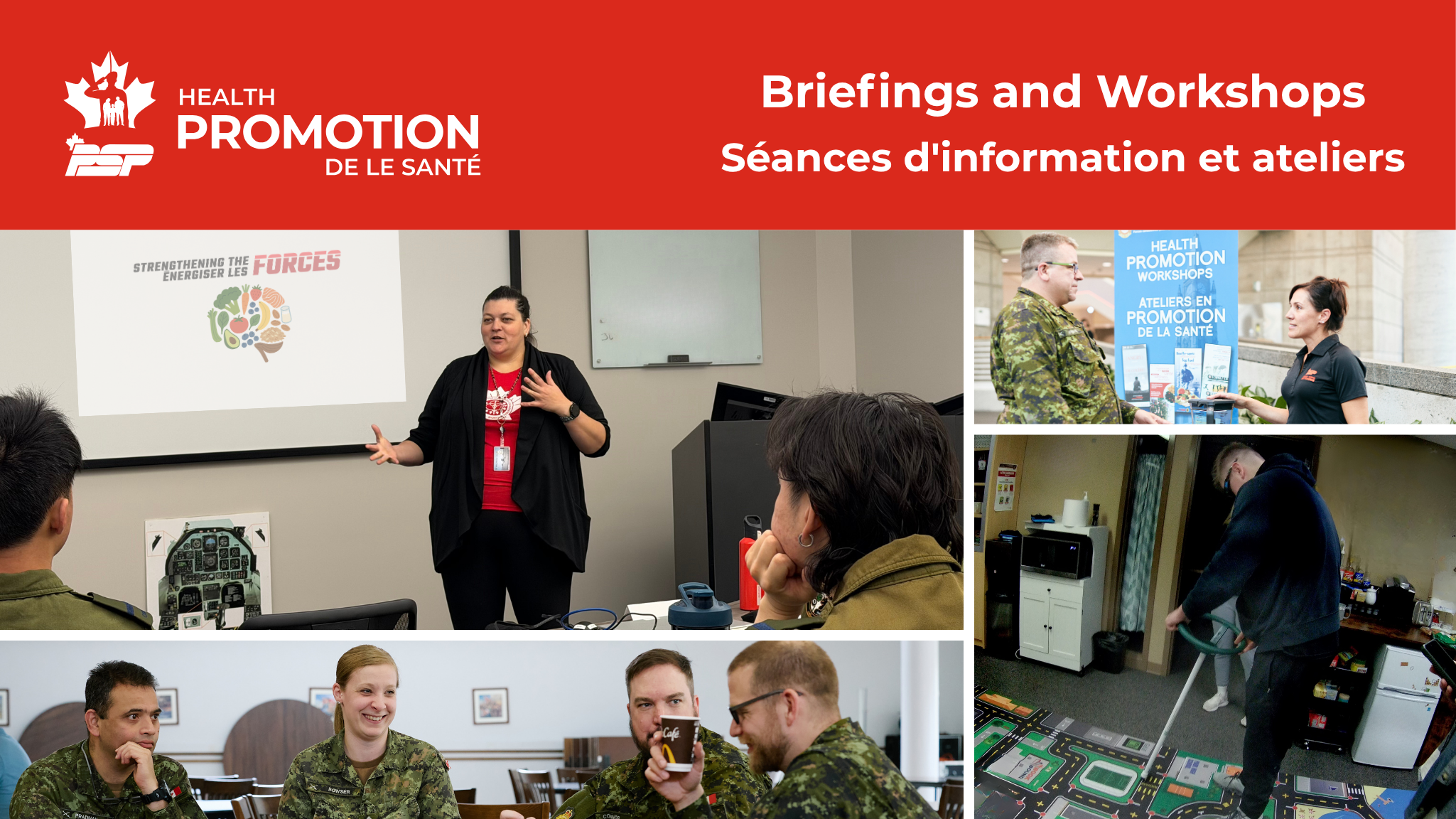
Nationally PSP Health Promotion helps CAF members adopt and maintain healthy lifestyles. At 15 Wing in Moose Jaw we provide courses and workshops to help CAF members, their families, and our defence partner employees acquire the knowledge and skills needed to make healthy lifestyle choices.
Health Promotion programming focuses on various areas, including active living, injury prevention, nutrition, sleep, social wellness, and addictions awareness. Behaviours and lifestyle choices in these areas are important determinants of health and wellbeing. So, by promoting healthy behaviours across these areas, we help CAF members optimize their health and wellbeing. By extension, we also help our members remain physically and mentally fit for deployment.
Dates and registration information is in each briefing description.
Please note that at this time briefings and workshops are delivered in English only
Veuillez noter qu'à l'heure actuelle, les séances d'information et les ateliers se déroulent uniquement en anglais.
-
Mental Fitness & Suicide Awareness
MITE Code Eligible
Mental Fitness and Suicide Awareness courses aim to build skills and awareness to strengthen individual and workplace mental health and reduce mental health injuries, including suicide. They cover stress management, recognizing distress, intervening in suicidal situations, creating personal action plans, and guiding supervisors in fostering a supportive culture. -
Prevent and Respond to Sexual Misconduct (PRSM)
27 OCT 2026 0800-2400hrs
Prevent and Respond to Misconduct of a Sexual Nature (PRSM) formerly known as RITCAF, equips Canadian Armed Forces (CAF) members with the knowledge and practical skills needed to help foster a culture of dignity, respect, and inclusion. Participants will develop a deeper understanding of conduct deficiencies of a sexual nature, harassment of a sexual nature, and crimes of a sexual nature, while exploring their impacts on individuals, teams, and the broader CAF community. Through discussion, reflection, and skill-building activities, participants will learn how to recognize concerns, challenge harmful behaviours, and contribute to a respectful and supportive environment.
Using a trauma-informed approach, the workshop emphasizes compassionate and effective ways to support individuals affected by sexual misconduct. Participants will gain confidence in responding appropriately, connecting affected personnel with available resources, and promoting a culture where all members feel safe, valued, and empowered. By the end of the workshop, participants will be better prepared to take a stand against harmful conduct and play an active role in prevention, response, and support efforts within the CAF.
Content Advisory
This workshop includes discussions of potentially sensitive topics, including sexual misconduct, harassment, trauma, mental health, suicide, addictions, and anger management. These topics are presented within the context of awareness, prevention, support, and available training opportunities. Participants are encouraged to engage at a level that feels appropriate and to access support resources if needed -
Alcohol, Other Drugs, Gambling, and Gaming Awareness
MITE Code Eligible
The Canadian Armed Forces (CAF) Alcohol, Other Drugs, Gambling and Gaming Awareness (AODGGA) addresses the need to provide an evidence based, uniform program across the CAF. The AODGGA was designed specifically for CAF personnel who want to increase their knowledge about alcohol, other drugs, gambling and gaming.
To understand and hopefully eliminate the effects of these issues, the Canadian Armed Forces has specifically developed the AODGGA course and supervisor training. This training will increase participants’ knowledge and understanding of a variety of issues related to alcohol, other drugs, gambling, and gaming. The goal of this course is to prepare personnel in leadership positions to deal with issues or problematic use in regard to alcohol, other drugs, gambling, and/or gaming with their units. Participants will learn about misuse, warning signs, effective interviewing skills, active listening skills, enabling and how to challenge and change unhealthy workplace cultures. Participants will also learn to apply CAF policies and understand the role or the supervisor in creating and promoting an addiction-free workplace.
-
Managing Angry Moments
MITE Code Eligible
Managing Angry Moments (MAM) helps participants understand and deal with their triggers before anger escalates. Participants learn new tools to defuse situations and develop coping strategies that will ultimately increase personal wellbeing and improve relationships with others. -
Essential Nutrition
This course is appropriate for adults who wish to learn and practice healthy eating habits. This course was developed by registered dietitians in collaboration with a public health medicine specialist physician. After this course, you will be equipped with the skills and knowledge to feel comfortable implementing the learning outcomes. Full Course workshops are offered as well as individual module briefings. Modules can be taken at any time in any order.
-
Fundamentals of Healthy Sleep
This sleep briefing is appropriate for adults who wish to learn and practice healthy sleep habits. Participants will learn about sleep architecture, how sleep impacts health and performance, learn about sleep health in the CAF, look at the determinants of sleep, and take away some sleep resources for their own learning.
-
Injury Reduction Strategies
Injury reduction strategies for sports and physical activity will increase your knowledge and understanding of where injuries occur in the Canadian Armed Forces (CAF). It will also provide you with strategies that you can use to reduce your chances of being injured. It provides lasting scientific evidence concerning injury prevention in sports and physical training. The benefit of the briefing is to increase local support for injury prevention initiatives.
-
Stress: Take Charge!
Stress: Take Charge! helps participants develop an understanding of the stress reaction based on their individual life stressors. Participants will learn tools and select coping mechanisms that they can use in everyday life to make changes and manage their stress levels.
-
Butt Out!
Quitting smoking (and other nicotine products) isn’t easy – but you don’t have to do it alone. Butt Out! Is an 8-week, evidence-based program designed to help you break free from nicotine addiction and the habits that keep you smoking. Through a structured workbook and expert support, you’ll explore your personal reasons for smoking, learn effective strategies to replace the habit, and build a personalized plan for long-term success.
The program combines behavioural techniques with optional medical support to ease withdrawal symptoms. Using the PLoTTing method (Pinpoint, Locate, Test, Train) you’ll develop a customized non-smoking blueprint that fits your lifestyle. Whether it’s your first attempt or your fifth, Butt Out! Helps you learn, adapt, and move closer to becoming smoke-free for good.
-
Inter-Comm
Improve communication within personal relationships by learning the attitudes and skills required to deal with conflict effectively. Through exercises and coaching, participants learn to: understand conflict and increase active listening skills, use a collaborative model for resolving conflict build on interest-based communication skills, and use collaboration and communication to support health and well-being in relationships.
-
Goal Setting
This 90-minute Goal Setting Briefing equips participants with practical tools to define meaningful goals and follow through with confidence. The session introduces evidence-based models of behavior change and shows how to make them work in real life, including strategies to set realistic goals, create stepwise action plans, and build habits that stick.
Participants learn how to anticipate common derailers, plan to stay on track, and how to recover quickly when obstacles arise. The briefing blends short instruction, interactive reflection, and peer discussion to help participants leave with one well-formed goal, a clear first step, and a personalized plan to maintain momentum.
